
Update on Austrian FDI
Authors: Johannes Barbist (Partner, Binder Grösswang) and Regina Kröll (Partner, Binder Grösswang)
Introduction
The Austrian Investment Control Act (Investitionskontrollgesetz “ICA”) has been in force for almost six years now. In June 2026, the Federal Minister for Economy, Energy and Tourism (“BMWET”) submitted the Fourth Activity Report on Investment Control, covering the period from 1 January 2024 to 31 December 2024 (“FDI-Report 2024”), to the Austrian National Council (one of the two chambers of the Austrian Parliament).
We have studied the report for you. And provide some key facts and conclusions.
Just before the summer break, we also provide a short outlook on the upcoming reform of the Austrian FDI screening regime. Spoiler: Austria will most likely remain a powerhouse in FDI terms and a jurisdiction to watch out in almost all international M&A transactions (with an Austrian entity or assets thereof involved).
Our takeaways from the Austrian FDI-Report 2024
General
In 2024, Europe again observed declining inward flows of foreign direct investments (“FDI”). The main reasons were geopolitical tensions, increased costs of financing, and a reluctant investment climate in Europe. Interestingly, the negative trend in Austria in the years 2022 and 2023 could be reversed in 2024.
Based on the overall FDI-holdings in Austria,
- the key countries of origin of investors are Germany, Russia, Switzerland, USA and Italy.
- Russia still is the No. 1 third country investor followed by USA, Canada, United Arab Emirates and UK.
Given that the typical reader of CELIS blogs is not interested in macro-economics, let us move to the Austrian investment screening and some statistics
Statistics on Austrian FDI screening
The Austrian FDI authority (BMWET) completed 135 FDI-cases in Austria, that can be classified as follows:
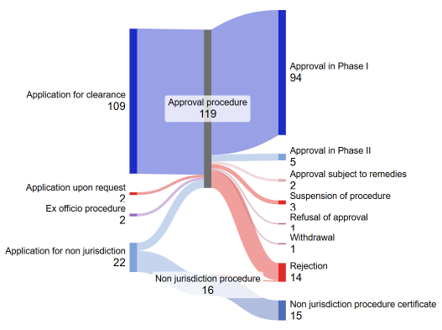
We interpret the statistics for 2024 as follows:
- Most of the cases are based on applications for clearance proactively submitted by foreign investors (94 out of 135).
- Applications for non-jurisdiction are still quite significant (22). 70% of these applications resulted in a (welcomed) decision that no FDI filing is required in Austria (15).
- Decisions imposing remedies are rare (2).
- 2024 saw the first FDI transaction for which the BMWET refused clearance. Typically, investors try to avoid a prohibition scenario by withdrawing the application for clearance in time.
- The number of rejected cases is quite high (13 applications for clearance, 1 application for non-jurisdiction) demonstrating – at least in parts – the legal uncertainty in the application of the ICA, in particular regarding the scope of the sensitive sectors, the qualification as foreign investor, the micro-enterprise exemption, the acquisition of controlling influence over material assets and the right to file an application for clearance (locus standi).
M&A transactions are only screened in Austria, if the investor is foreign (non-EU, non-EFTA). In 2024, the investors originated from the following countries (multiple entries possible):

The chart shows that, out of 135 FDI proceedings, 69 had a U.S. connection and 25 a nexus to UK, making the US and the UK the top countries of origin (of investors complying with notification obligations under the ICA).
Not surprisingly, most of the FDI transactions screened in Austria in 2024 were again share deals:

The transactions screened in 2024 concerned the following sensitive sectors:

What to expect from Austrian FDI in the future
All EU member states need to adapt their laws to the revised EU FDI screening regime. In Austria, these efforts will go hand in hand with various “stand alone” changes to the ICA. A draft proposal has not yet been published, the debate about finding a balance between an open economy and a proportionate FDI screening framework is ongoing with an unclear outcome as of yet.
What can be expected:
- Extension of the review periods (phase 1, phase 2)
- A much lower number of FDI filings from Austria will be sent into the EU cooperation mechanism.
- The contents of FDI filings will be extended.
- A partial exemption for internal restructurings will be introduced which should hopefully solve the legal uncertainty in this area.
- The interplay between the BMWET and the Commission / other members states will be adapted.
- The benchmark for initiating phase 2 and the possibility to impose mitigating measures or to prohibit the foreign investment will be tightened (test of likelihood to negatively affect security or public order).
What can potentially be expected:
- Only investors from the EU being privileged.
- Greenfield investments may be caught.
- The exemption for micro-enterprises being deleted or adapted to only apply if the Austrian target company does not operate in a highly critical sector.
- The current regime of mandatory filing and implementation ban until clearance may be opened to allow for voluntary filings / call-in powers of the BMWET for transactions in less-critical sectors.
- The sanctions regime could be changed from criminal penalties to administrative (corporate) fines.
Austria will continue to be an important jurisdiction in FDI terms. We will keep you informed about the new legislative developments – for the moment we wish you a great summer.
This blog was also published on the Binder Grösswang website, which you can access here.
